Teaching commenced in 1911 at Old Government House in George Street, Brisbane, with three faculties—Arts, Science, and Engineering—and 83 students, including 23 women. The university expanded rapidly, and in 1926, Dr James O’Neil Mayne and his sister Miss Mary Emelia Mayne provided the funds to purchase the St Lucia site where the main campus now stands. Construction began in 1937, and the first building, the Forgan Smith Building, was completed in 1939. During World War II, it served as the advanced headquarters for the Allied Land Forces in the South West Pacific.
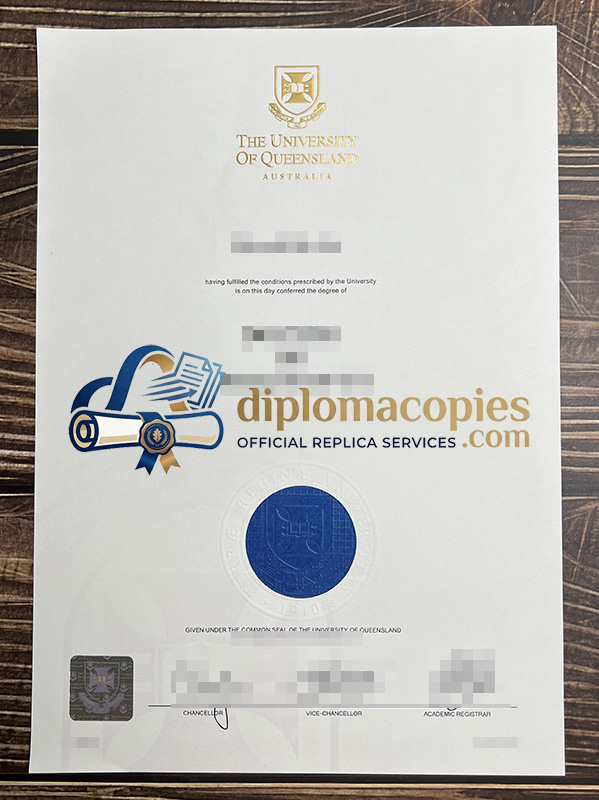
UQ’s commitment to serving Queensland beyond the capital is deeply embedded in its institutional identity. The 1990 merger with the Queensland Agricultural College at Gatton united the state’s two oldest higher education institutions. Today, UQ’s regional footprint includes clinical schools with training hubs in Rockhampton, Bundaberg, Hervey Bay, and Toowoomba, which have graduated over 1,500 medical students who received clinical training in rural and remote locations. #Replica a University of Queensland degree online. The Young Achievers Program, established in 2009, has supported more than 1,200 students facing financial hardship or educational disadvantage, providing mentoring, financial assistance, and accommodation support.
UQ’s research credentials are exceptional. The university ranks among the world’s top 50 universities, with particularly strong performance in research quality and industry engagement. In the 2027 Times Higher Education World University Rankings, UQ achieved an industry score of 99.6 and a research quality score of 87.4, reflecting its capacity to translate discovery into real-world impact. TIME Magazine’s inaugural World’s Top Universities ranking named UQ Australia’s best university and 38th globally, citing its graduates’ contributions to global economic decision-making and advancements in science and technology. UQ diploma, UQ degree, UQ certificate.
The university’s research output is prodigious. The Nature Index ranks UQ fourth in Australia overall and first in biological sciences, with significant strengths in health sciences and applied sciences. UQ has received more fellowships and awards from the Australian Research Council than any other Australian university, and 100 percent of its research is rated at or above world standard.
UQ’s research has produced innovations with global reach and tangible human benefit. Professor Ian Frazer and his team developed the vaccine that prevents human papillomavirus (HPV), the cause of nearly all cervical cancers. Following its rollout in Australia, HPV infection rates among young women plummeted from 22.7 percent to 1.5 percent by 2015, and efforts continue to make the vaccine available worldwide. Where to buy a University of Queensland diploma online?
In materials science, UQ researchers developed a bioplastic composite made entirely from biobased materials, including fibres derived from Australian organic waste, that offers the same properties as conventional plastics but biodegrades completely in fresh water, ocean, and soil. Professor Lianzhou Wang’s team created a solar cell achieving 16.65 percent efficiency, a significant leap, using sustainable materials and flexible designs.
The Institute for Molecular Bioscience (IMB) exemplifies UQ’s capacity for commercial translation. Over its 25-year history, IMB research has attracted more than $3 billion in investment, generated 20 spin-out companies, and produced innovations ranging from drugs derived from deadly spider venom to pheromone lures that disrupt cane toad breeding. Professor Kate Schroder’s work on inflammasome inhibitors, commercialised by Inflazome Ltd and acquired by Roche, targets chronic inflammatory diseases including Parkinson’s and Alzheimer’s.
UQ’s commercialisation arm, UniQuest, has created more than 136 startups from university intellectual property. In 2025, Sanofi’s acquisition of UQ vaccine startup Vicebio for US$1.15 billion represented the largest deal involving IP from an Australian university.