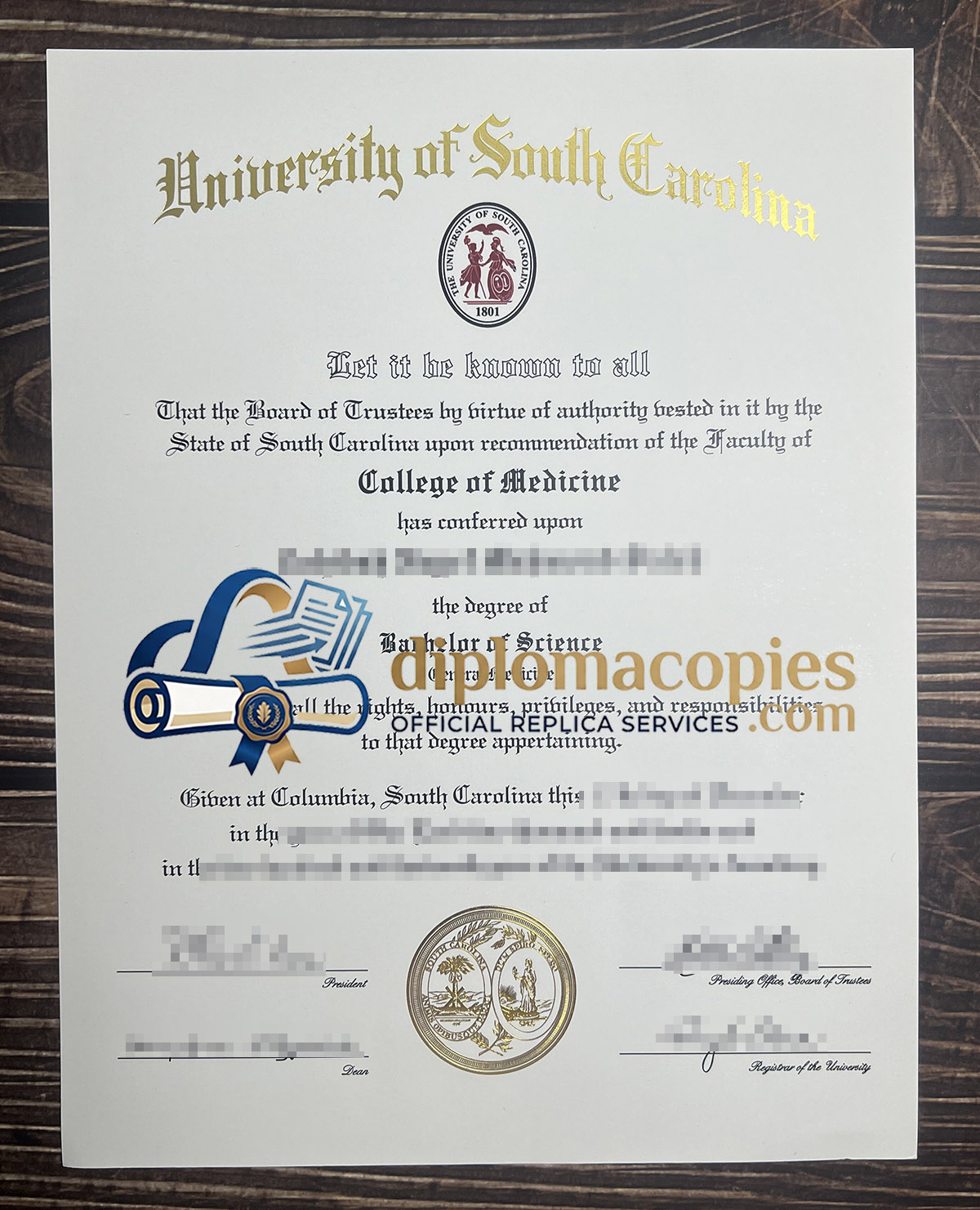
The college quickly earned a reputation as a training ground for the state's antebellum elite. Its faculty included notable European scholars like Francis Lieber and Thomas Cooper, as well as the distinguished American scientists John and Joseph LeConte. With a classical curriculum emphasizing Latin, Greek, and moral philosophy, South Carolina College became one of the South's most influential institutions of higher learning. #Replica a University of South Carolina degree online.
The university's early history was anything but smooth. The Civil War brought devastation: the college closed in 1861 for want of students, and Confederate forces used campus buildings as a hospital during the conflict. What followed was even more turbulent. During Reconstruction, the institution briefly became one of the only Southern state universities to admit and grant degrees to African American students, with the first Black students enrolling in 1873 and Richard T. Greener serving as the university's first African American professor.
That experiment ended abruptly. In 1877, conservative state leaders closed the university and reopened it in 1880 as an all-white agricultural college. The institution spent the next quarter-century lurching through political reorganizations, its status shifting repeatedly between "college" and "university" as the state's political winds changed.
Stability came gradually. Women were admitted in 1895, though they were not permitted to live on campus for decades. I want to buy a University of South Carolina degree online. In 1906, the institution was recharacterized for the final time as the University of South Carolina. Regional accreditation followed in 1917—the first for any state-supported college in South Carolina.
The Great Depression stalled progress, but World War II proved transformative. Naval training programs brought thousands of servicemen to campus, and after the war, enrollment more than doubled as veterans took advantage of the G.I. Bill. The 1950s and 1960s saw the university begin recruiting national-caliber faculty and expanding its footprint with regional campuses across the state. USC diploma, University of South Carolina diploma in USA.
Desegregation came in 1963, when Henrie D. Monteith, Robert Anderson, and James Solomon enrolled under federal court order, becoming the first African American students at the university since Reconstruction. The same period brought explosive growth: enrollment stood at 5,660 in 1960 and nearly quadrupled within two decades.