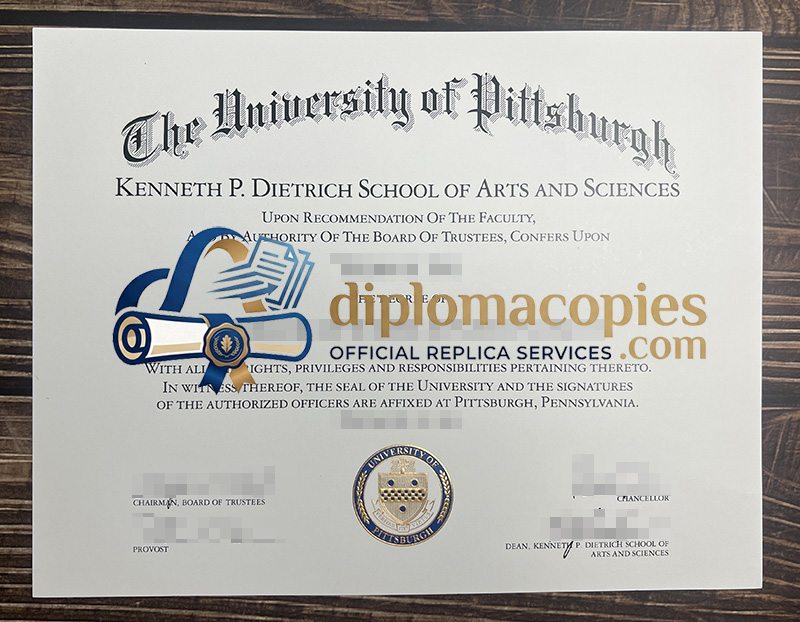
The University of Pittsburgh (Pitt) occupies a distinctive place in American higher education: founded on the frontier in 1787, it has evolved into a world-class research institution whose breakthroughs have saved millions of lives and reshaped modern medicine. From the polio vaccine to organ transplantation, from CPR to vision restoration, Pitt’s history is defined by a willingness to attempt what others deemed impossible. University of Pittsburgh diploma, University of Pittsburgh degree, University of Pittsburgh certificate. Pitt diploma in USA.
Pitt‘s story begins in the early spring of 1781, when an ambitious young Philadelphia lawyer named Hugh Henry Brackenridge crossed the Alleghenies to seek his fortune in Pittsburgh. As he wrote, “My object was to advance the country and thereby myself”. He founded Pittsburgh Academy in 1787—the same year the U.S. Constitution was signed—making Pitt one of the oldest continuously chartered institutions of higher education in the United States.
The institution evolved into the Western University of Pennsylvania in 1819 before receiving its current name upon relocating to its Oakland campus in 1908. For most of its history, Pitt operated as a private institution until becoming part of Pennsylvania’s Commonwealth System of Higher Education in 1966.
The university’s rise to international prominence was neither linear nor inevitable. The 1986 institutional history “Pitt: The Story of the University of Pittsburgh” documents “drama, tragedy, controversy and politics”—including the firing of a controversial professor, the resignation of legendary football coach Jock Sutherland, and the financial gambles of Chancellor Edward Litchfield that nearly bankrupted the institution. How do i buy a University of Pittsburgh diploma?
Financial stability came gradually under Chancellor Wesley Posvar, who guided Pitt through the turbulent 1960s and into its emergence as a force in international higher education.
Pitt’s research legacy is extraordinary by any measure. In 1955, Jonas Salk and his team at Pitt’s School of Medicine developed the polio vaccine, declared “safe, effective, and potent”—an achievement hailed as one of the great medical breakthroughs of the 20th century. Global polio cases have since declined by more than 99 percent.
Thomas Starzl, Pitt’s Distinguished Service Professor of Surgery, performed the world’s first successful liver transplant and pioneered the immunosuppressive drugs that made organ transplantation routine. He received the National Medal of Science in 2006 and the Lasker-DeBakey Clinical Medical Research Award in 2012. Peter Safar, known as the “father of CPR,” created modern resuscitation and intensive care, and established the United States’ first EMS system.
The university’s impact extends into the brain itself. Paul Lauterbur, a Pitt PhD, won the 2003 Nobel Prize in Medicine for his invention of the MRI machine. Pitt researchers developed Pittsburgh Compound B (PiB), enabling the first imaging of amyloid plaques in living Alzheimer‘s patients, and pioneered brain-computer interfaces allowing paralyzed individuals to control robotic arms through brain signals. Bennet Omalu, while at Pitt, I need a University of Pittsburgh degree certificate online. discovered chronic traumatic encephalopathy (CTE) in football players, fundamentally changing how contact sports approach brain injury.
Most recently, in October 2026, Pitt researchers published in the New England Journal of Medicine results showing that optogenetic therapy—a technique delivering light-sensing proteins into surviving retinal cells—safely improved visual function in patients with advanced retinitis pigmentosa, a leading cause of inherited blindness. José-Alain Sahel, who led the study, noted that “even in people with profound vision loss, the visual system retains a remarkable capacity to process new information”. This work earned Sahel and collaborator Botond Roska the 2026 António Champalimaud Vision Award, the largest prize in vision research.